Since entry into the industry is free in case of perfect competition, the existence of excess profits (sometimes called super normal profits) attract other firms to enter the industry. Or alternatively, existence of excess loss would cause some firms to exit the industry.
As new firms enter the industry, supply also increases. Due to the increased supply, the price in the market will fall and hence the price charged by the firm will also fall. The higher profits that were being enjoyed by the firms will start to drop.
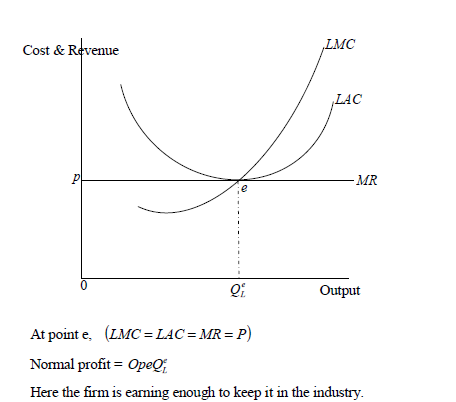
In the long run, the firm will be at equilibrium when the excess profits have been exhausted and no new firms are attracted to enter the industry and when there are no loses to force the firm will be in the long run equilibrium when it is only enjoying normal profits.
A normal profit is defined as the rate of returns on capital just sufficient to provide capital investments necessary to develop and operate a firm.
The firm would enjoy normal profits where the long run marginal cost of the firm equals average cost and equal marginal revenue (LMC = LAC = MR = P), that is, at the point where long run AC is at its minimum.
Wilfykil answered the question on
March 7, 2019 at 10:45