-
Outline the main differences between ruminants and non-ruminants
Date posted:
March 28, 2019
-
Describe the factors to consider when selecting a gilt for breeding.
Date posted:
March 28, 2019
-
Explain cropping in fish farming.
Date posted:
March 28, 2019
-
Give reasons why honey harvesting at night is not encouraged.
Date posted:
March 28, 2019
-
What factors influence siting of calf pens?
Date posted:
March 28, 2019
-
Give the maintenance practices of a permanent calf pen.
Date posted:
March 28, 2019
-
State the factors to consider in siting a rabbit hutch.
Date posted:
March 28, 2019
-
State the reasons for raising rabbit hutches above ground level.
Date posted:
March 28, 2019
-
State the functions of the following parts of a mouldboard plough
i) Landside
ii) Mouldboard
iii) Coulter
iv) Share point.
v) Frog
vi) Depthwheel
Date posted:
March 28, 2019
-
List the factors that should be considered when grading eggs for marketing.
Date posted:
March 28, 2019
-
Use the information provided below to calculate the gross margin of beans per hectare.

Date posted:
March 28, 2019
-
State the common features of ranching as a farming system:
Date posted:
March 28, 2019
-
Why does the Kenya government put a lot of emphasis on ranching?
Date posted:
March 28, 2019
-
State the limitations of mixed farming
Date posted:
March 28, 2019
-
Below is a diagram of a sheep with some parts labeled A, B, and C. Study
the diagram and answer the questions that follow.
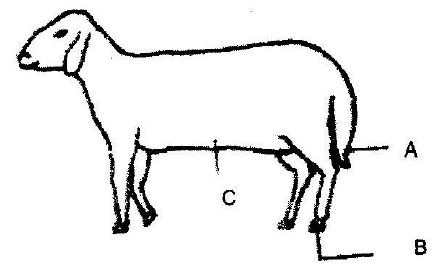 (i) What operation is usually carried out on the part labeled A during a sheep’s early stages of life?
(ii) Why is it necessary to carryout the operation in (i) above?
(iii) At what stage of sheep should the operation in (i) above be carried out?
(iv) Give two methods of carrying out the operation in (i) above,
(v) Which operation is usually carried out on part labeled B
(vi) What problem would occur if the operation in (V) above is not carried out?
(vii) How should the sheep beheld when shearing wool around part labeled C?
(i) What operation is usually carried out on the part labeled A during a sheep’s early stages of life?
(ii) Why is it necessary to carryout the operation in (i) above?
(iii) At what stage of sheep should the operation in (i) above be carried out?
(iv) Give two methods of carrying out the operation in (i) above,
(v) Which operation is usually carried out on part labeled B
(vi) What problem would occur if the operation in (V) above is not carried out?
(vii) How should the sheep beheld when shearing wool around part labeled C?
Date posted:
March 25, 2019
-
The diagram below shows an experiment set up using soil types
&, H and J and observations made after 24 hours. Study the diagram and answer the questions that follow.
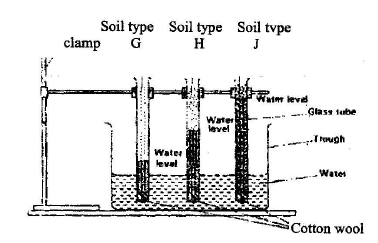 i) What is the experiment represented above designed to study?
ii) Name the three soil types & H and J.
iii) What is the characteristic texture of soil types G and J?
iv) State how a farmer would improve the structure of soil type G.
i) What is the experiment represented above designed to study?
ii) Name the three soil types & H and J.
iii) What is the characteristic texture of soil types G and J?
iv) State how a farmer would improve the structure of soil type G.
Date posted:
March 25, 2019
-
State four factors that a farmer should consider before buying a
tractor for use as the source of power on the farm.
Date posted:
March 22, 2019
-
State four advantages of using a Kenya Top Bar Hive over log hive.
Date posted:
March 22, 2019
-
Describe the procedure of erecting wooden posts for fencing.
Date posted:
March 22, 2019
-
List any four types of records a farmer should keep.
Date posted:
March 22, 2019
-
State two characteristics of goats that make them adaptable to
arid areas of Kenya.
Date posted:
March 22, 2019
-
State three advantages of overhead irrigation compared to
surface irrigation.
Date posted:
March 22, 2019
-
Name four types of water pumps which can be used on the farm.
Date posted:
March 22, 2019
-
Outline TEN Agricultural research organizations governing agricultural sector in Kenya.
Date posted:
March 16, 2019
-
What are the factors Influencing crop rotation programme?
Date posted:
March 16, 2019
-
Explain in details plant spacing giving examples of different plants and the spacing area
Date posted:
March 16, 2019
-
Given that maize is planted at a spacing of 75 x 25 cm, calculate the plant population in a plot of land measuring 4 x 3 m.
Date posted:
March 16, 2019
-
Types of planting materials,their advantages and disadvantages
Date posted:
March 15, 2019
-
A farmer was asked to apply fertilizers as follows:
200kg/ha of DSP (40% P205
150kg/ha of muriate of potash (60% K20)
150kg/ha of sulphate of ammonia (20% N)
How much P205 did the farmer apply per acre?
How much K20 did the farmer apply per hectare?
How much N did the farmer apply per hectare?
Date posted:
March 15, 2019
-
A farmer was asked to apply fertilizers as follows:
60 kg/ha nitrogen (top dressing)
60 kg/ha P205 (in planting hole).
60 kg/ha K20. How much sulphate of ammonia (20%) would be required per hectare? How much double super-phosphate (40%) P2O5would be required per hectare? How much muriate of potash (50% K20) would be required per hectare?
Date posted:
March 15, 2019